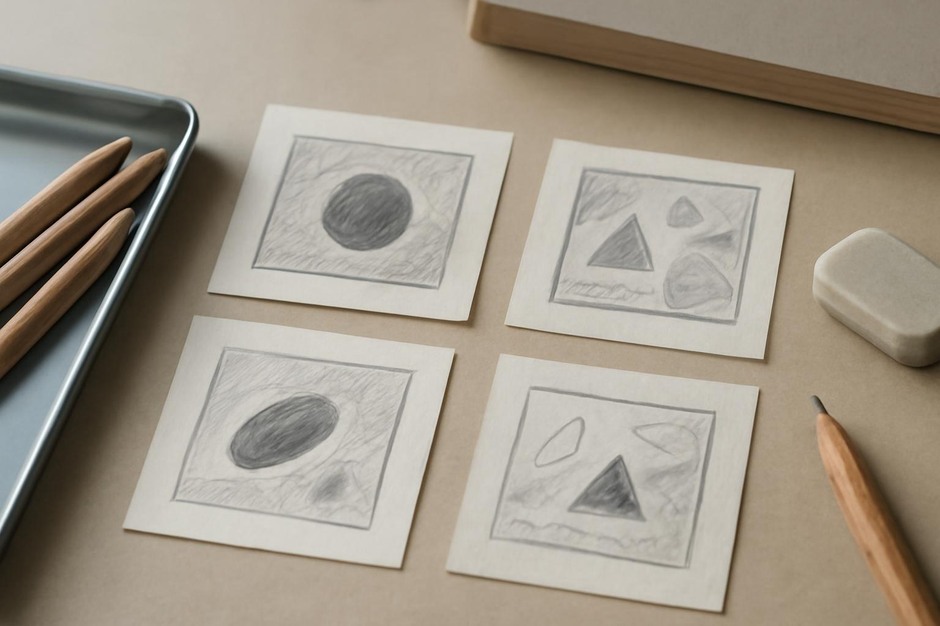
Anchoring the Eye: Focal Points and Peripheral Shapes in Tiny Sketches
What anchors the eye?
An anchor is a place where the eye rests. In thumbnail work, anchoring clarifies composition by establishing a primary point of interest and arranging secondary shapes around it. Different anchoring strategies lead to different balances and rhythms. This note compares two common strategies—direct anchoring and distributed anchoring—and provides brief exercises to test each.
Direct anchoring: a single visual weight
Direct anchoring places one dominant element—often darker, larger, or higher contrast—near a deliberate spot. This creates a clear hierarchy and frees peripheral shapes to act as support or counterbalance.
- Effect on composition: Strong clarity and a predictable path for the eye.
- Use when: You want a clear narrative anchor or a defined point of rest.
- Watch for: Overemphasis that makes other areas feel incidental unless they are intentionally composed.
Distributed anchoring: multiple minor anchors
Distributed anchoring spreads visual interest across several smaller elements that together form a network of attention. There may be no single dominant point; instead, the eye travels between beats.
- Effect on composition: A more conversational flow and even pacing.
- Use when: You want movement without a single obvious resting place.
- Watch for: Diffuse attention if repeats lack contrast or spacing discipline.
Short exercises
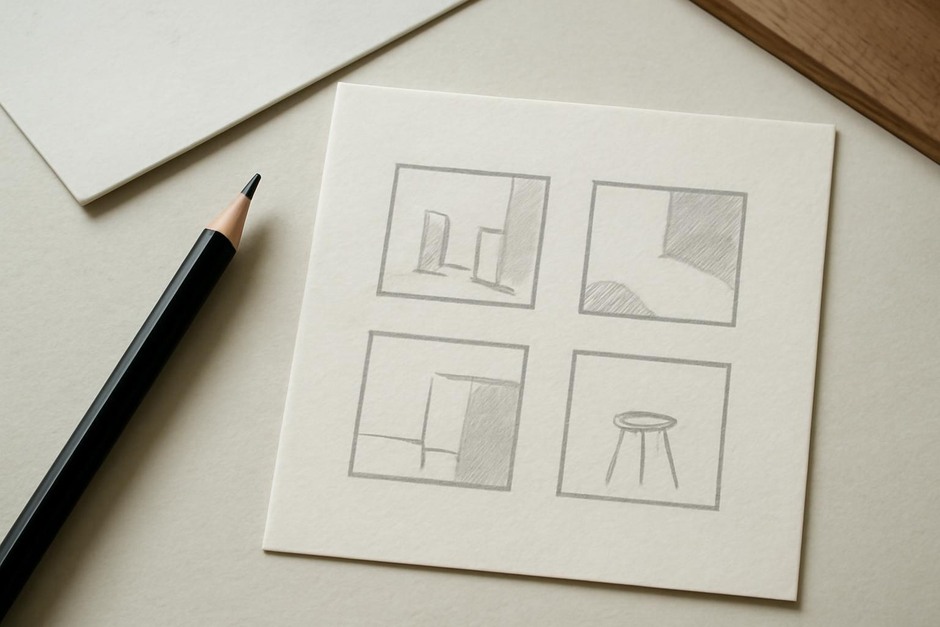
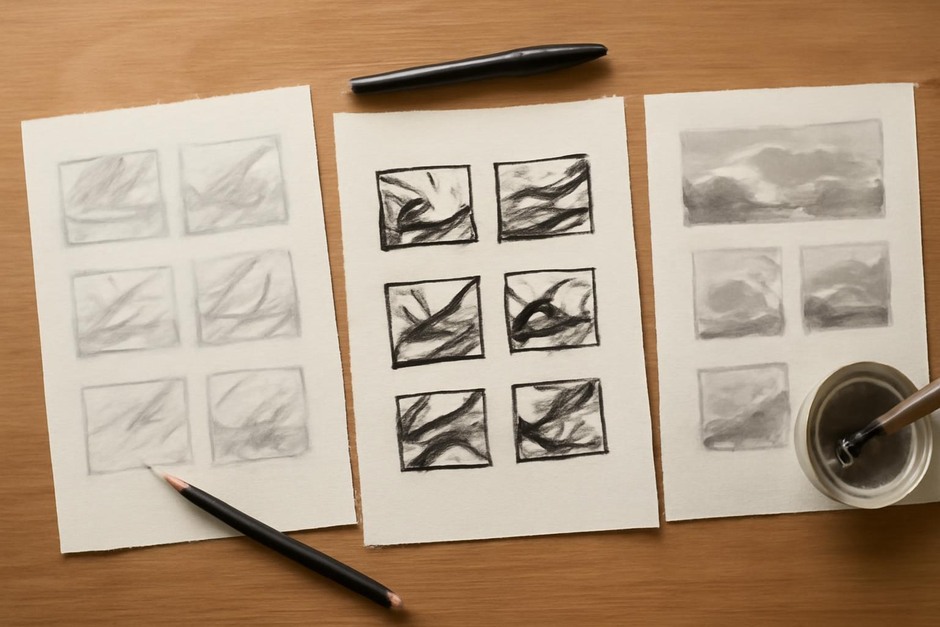
- Spotlight study: Make three thumbnails. In each, place one bold dark mass as the anchor and arrange three light peripheral shapes. Note how spacing enhances or diminishes the anchor.
- Cluster study: Make three thumbnails with several medium-value shapes distributed across the page. Experiment with clustering and spacing to guide a path through the composition.
- Swap test: Take a successful direct anchor thumbnail and convert it to a distributed model by breaking the anchor into smaller related shapes. Compare the reading and pacing.
Reading results
Direct anchors are efficient at communicating intention; they make a composition legible at a glance. Distributed anchors offer richer exploratory experiences, where rhythm and relationship matter more than a single answer. The choice is not binary: a composition can use a primary anchor while allowing secondary anchors to pull attention in subordinate ways.
In thumbnail practice, alternate these strategies. Direct anchoring is useful when testing a composition’s communicative clarity, while distributed anchoring trains the eye to negotiate multiple relationships and subtle pacing. Keeping a small record of which approach you used and how the eye travels will deepen your sense of how anchors function in different contexts.
Anchors are compositional decisions you can practice deliberately. By comparing direct and distributed methods in short, focused thumbnails, you learn how to set intentional points of rest and motion that support the visual story you want to tell.