Material Choices for Miniatures: Pencil, Ink, and Wash in Thumbnail Practice
Why material matters
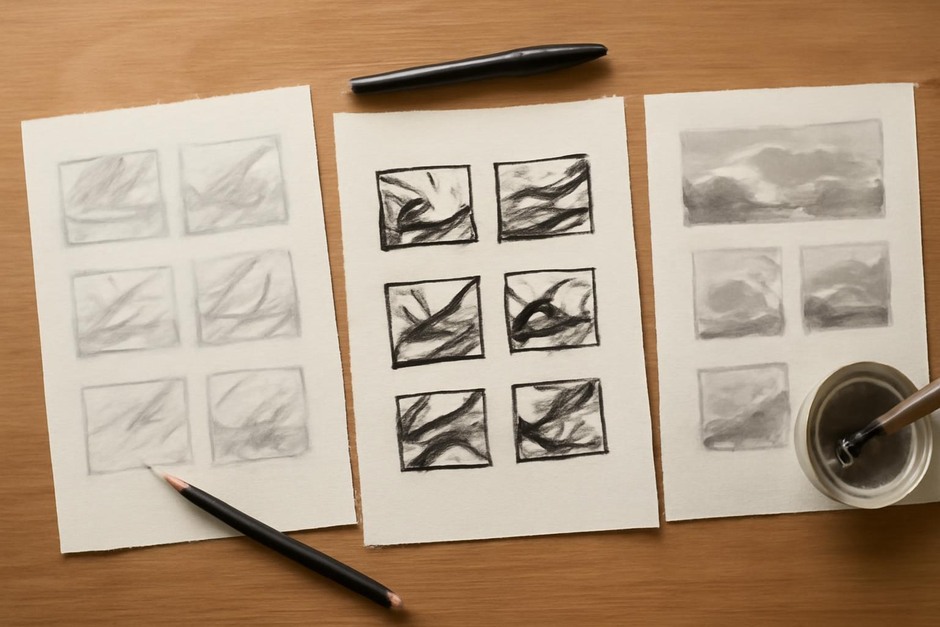
The medium you choose for thumbnails affects what the exercise trains. Pencil encourages nuance and gradation, ink insists on decisive marks, and wash emphasizes global value relationships. Comparing these materials in short, repeatable studies clarifies how each supports different compositional skills.
Pencil: modulation and subtlety
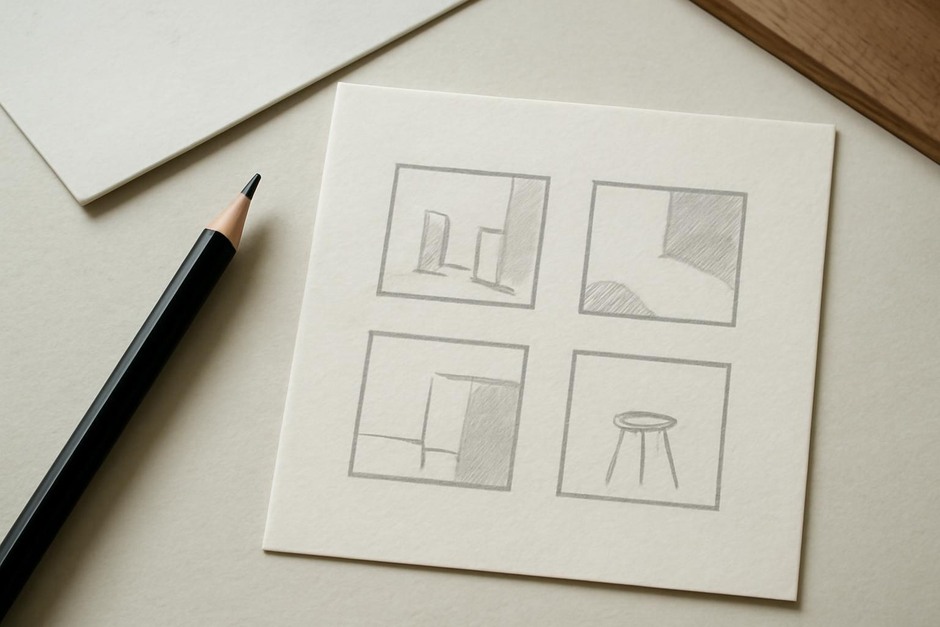
Pencil thumbnails allow small value changes and soft edges. They are suited to exercises that explore subtle shifts in weight and gentle rhythm.
- Strengths: Erasability, tonal range, and edge control.
- Good for: Testing small gradations in balance and refining peripheral rhythm.
- Practice tip: Limit time to avoid overworking; let the pencil suggest rather than resolve everything.
Ink: immediacy and clarity
Ink requires commitment. Marks are typically bolder and harder to alter, which encourages decisive compositional choices.
- Strengths: Strong contrast, crisp edges, and clear silhouette decisions.
- Good for: Training confident anchoring and edge relationships.
- Practice tip: Use brush or pen to vary line weight quickly; embrace the permanent character of ink as a constraint that sharpens choices.
Wash: mass and atmosphere
Wash thumbnails focus on broad tonal masses. They are effective for seeing balance across a whole page rather than in discrete shapes.
- Strengths: Rapid establishment of global value and soft transitions.
- Good for: Understanding overall weight distribution and creating rhythmic gradients.
- Practice tip: Limit the value range to three steps—dark, mid, light—to clarify relationships without overcomplication.
Material-focused exercises
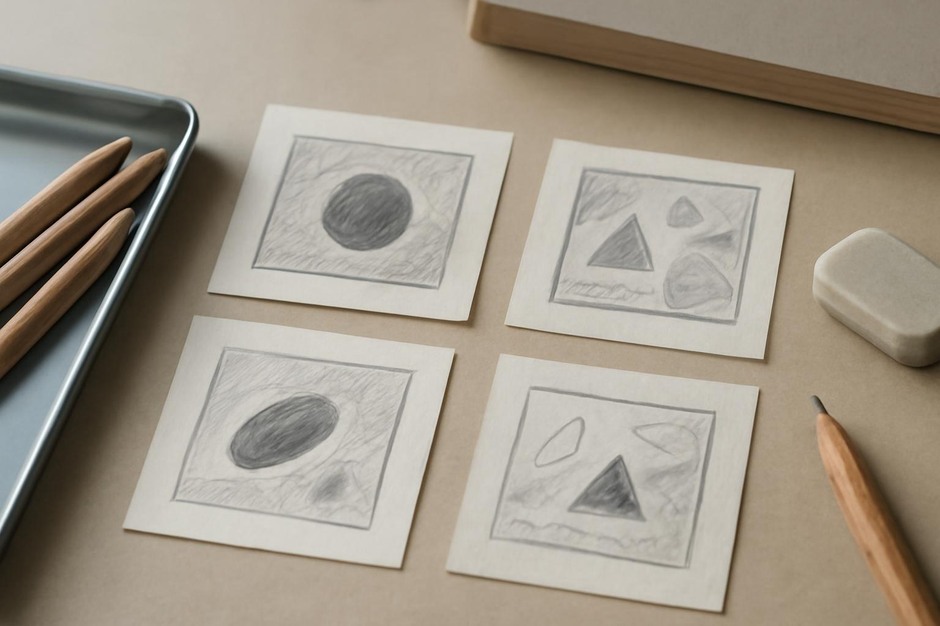
- Pencil nuance: Spend ten minutes creating three thumbnails that vary a single peripheral shape’s tone slightly while keeping anchor constant.
- Ink decisiveness: Make five one-minute thumbnails emphasizing a single bold silhouette and rapid line contrasts.
- Wash massing: Create three thumbnails using three values only. Focus on where darks and lights meet to form rhythm.
Comparing outcomes
Pencil sessions often reveal tendencies toward hesitation and micro-adjustment; they are useful for tuning sensitivity. Ink sessions reveal where hesitation would hinder legibility and force clearer decisions. Wash sessions expose where weight accumulates and how soft transitions affect pacing. Alternating materials trains a broader visual skill set: use pencil to listen, ink to speak, and wash to compose the room.
Material choice is not about right or wrong; it is about what you want the practice to teach. Making thumbnails across different media and reflecting briefly on the differences refines both perceptual acuity and tactical flexibility in composition.